
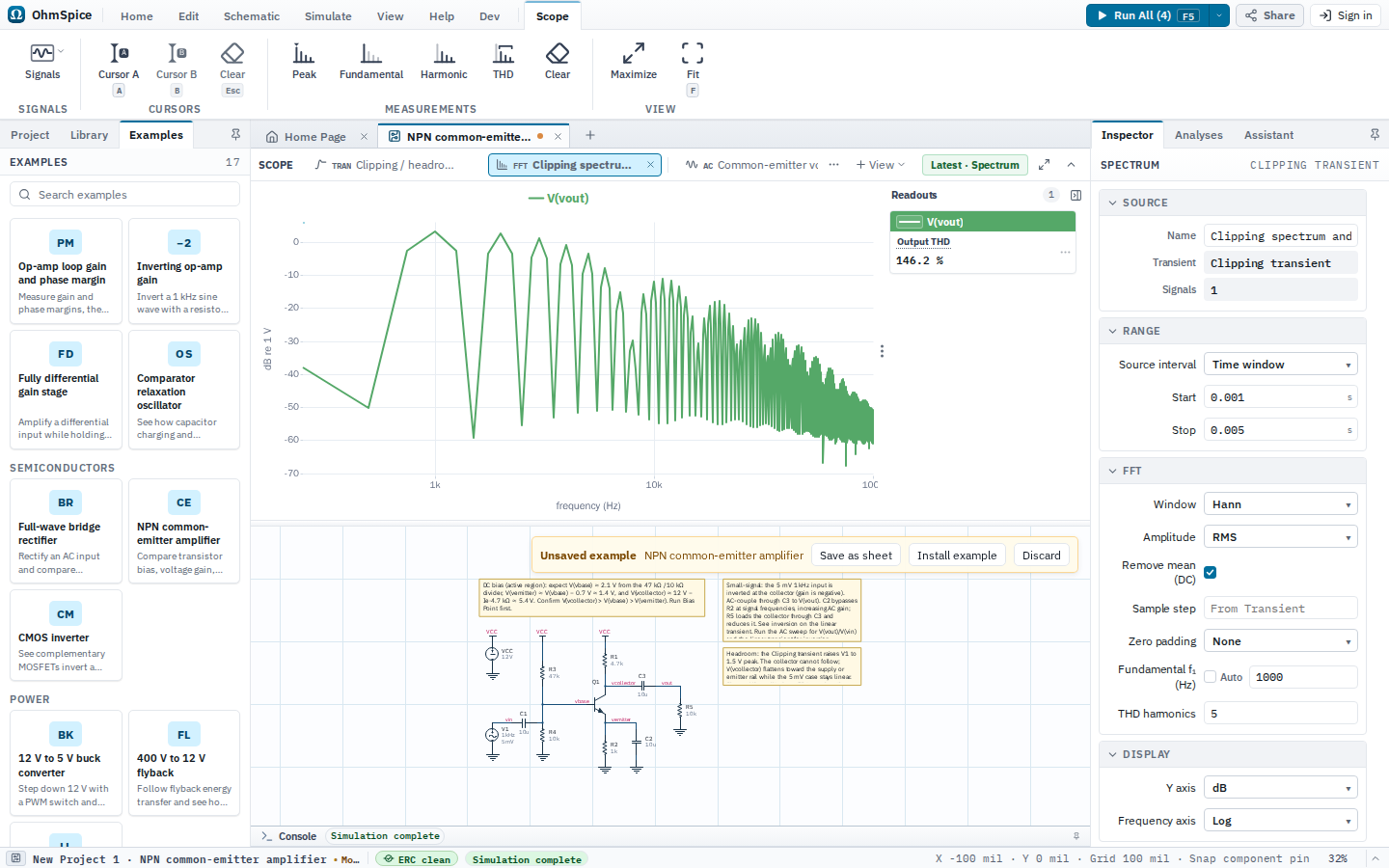
Start with Bias Point, then inspect transient gain, AC gain, and clipping. Select Clipping spectrum and THD to see the output harmonics from the final four cycles. The view uses a 1 kHz fundamental, a Hann window, and five harmonics above the fundamental.
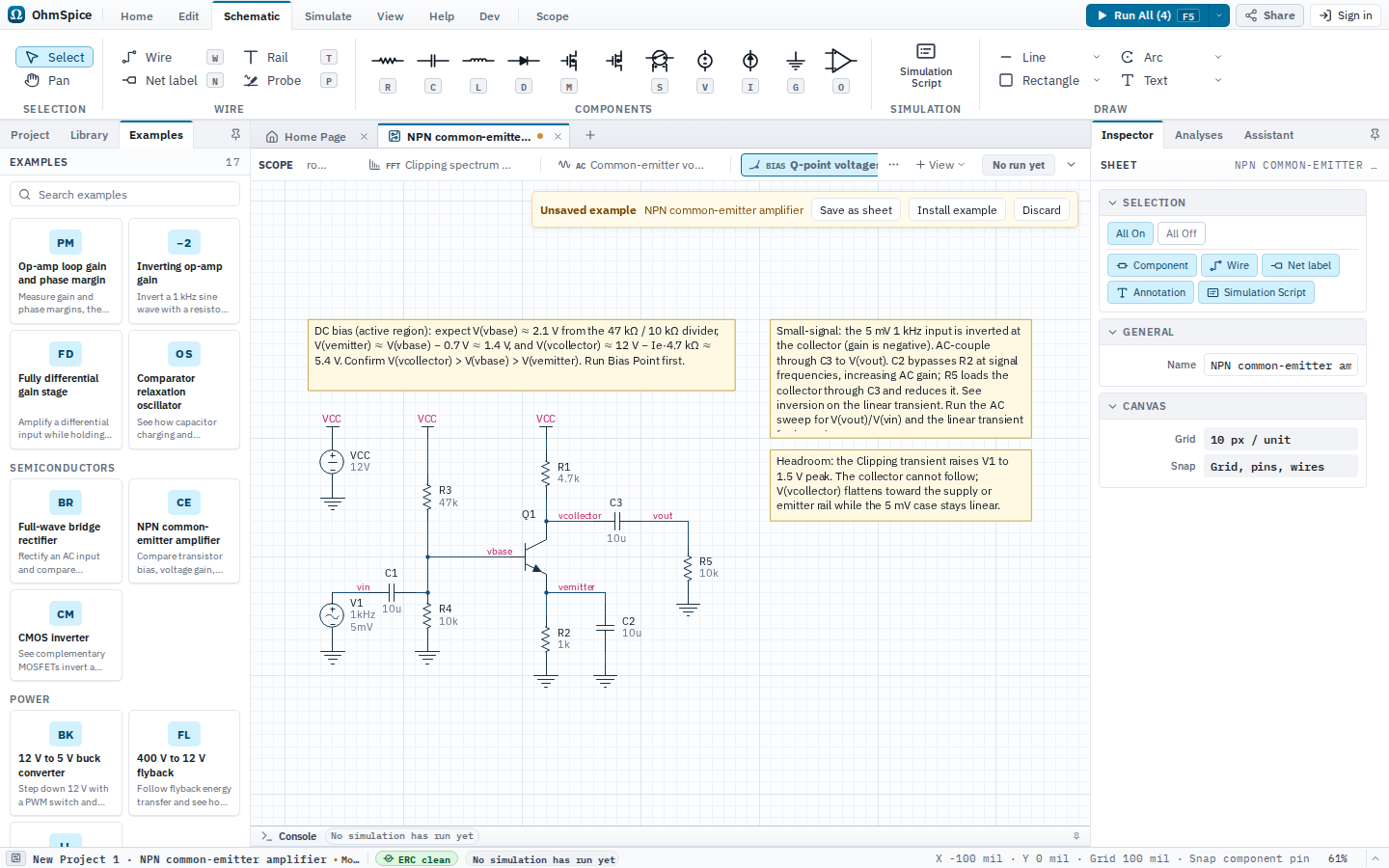
Open and run
- Open Examples from the Home ribbon.
- Choose NPN common-emitter amplifier.
- Open Simulate and choose Setup to review the analyses.
- Choose Run for one analysis or Run All for the complete configured set.
- Select a matching Scope view after the run. Use Save as sheet to keep the example or Discard to close it.
Sheets, analyses, and Scope
NPN common-emitter amplifier
Setup: Common-emitter bias, gain, and headroom
| Analysis | Configuration |
|---|---|
| 1 kHz transient gainTransient |
|
| Clipping transientTransient |
|
| Small-signal voltage gainAC |
|
| Bias Point | Default settings |
Scope views and expected results
Q-point voltages
Analysis: Bias Point
Bias Point
V(vbase)V(vemitter)V(vcollector)
Readouts
- Base voltageLast
V(vbase) - Emitter voltageLast
V(vemitter) - Collector voltageLast
V(vcollector)
Common-emitter transient response
Analysis: 1 kHz transient gain
Input and output waveforms
- V(vin) input
V(vin) - V(vout) AC-coupled output
V(vout)
Readouts
- Input swing (pk-pk)Pk-Pk
V(vin) - Linear output swing (pk-pk)Pk-Pk
V(vout)
Common-emitter voltage gain
Analysis: Small-signal voltage gain
Small-signal gain
- Vout / Vin
V(vout)/V(vin)
Readouts
- Gain at 100 kHzLast
V(vout)/V(vin)
Clipping / headroom
Analysis: Clipping transient
Large-signal collector
- V(vin) 1.5 V peak
V(vin) - V(vcollector) clipped
V(vcollector) V(vout)
Readouts
- Collector maxMax
V(vcollector) - Collector minMin
V(vcollector)
Clipping spectrum and THD
Analysis: Clipping transient
Output harmonics
V(vout)
Readouts
- Output THDTHD
V(vout)
Python scripts
No Python scripts are included with this example.